
TLDR
MTG slang is basically shorthand for “I’ve said this same thing 10,000 times and I’m tired.”
Learn three buckets and you’ll understand 90% of table talk: color names (Azorius, Jund), gameplay verbs (bounce, wrath, tutor), and vibe words (jank, stax, battlecruiser).
If you’re ordering proxies, the slang that matters most is the boring stuff: quantities (1x vs playset), multi-faced cards (DFC/MDFC), and “maybeboard” chaos.
When in doubt, ask. Anyone who gets mad at a genuine rules or slang question is announcing they’re not fun to play with, which is useful information.
Magic: The Gathering has a lot of words already. Keywords, reminder text, Oracle text, three separate ways to say “draw a card” depending on the decade. And then we added common MTG slang on top of that, because apparently the only thing we love more than cardboard is reinventing language to save two seconds.
This guide is here so you can follow conversations at the LGS, parse decklists, and generally avoid the awkward “yeah totally” nod when you have no idea what “blink your value engine and hold up interaction” means.
Common MTG slang for colors and deck names
If you hear someone describe a deck as a place name (or a guild, clan, shard, or whatever lore category your brain refuses to store), they are almost always telling you the colors.
The five colors, the wheel, and the alphabet soup
WUBRG: White, Blue, Black, Red, Green. Also called “Rainbow” or “five-color.”
Splash: “I’m mostly two colors, but I’m being greedy and adding a little of a third.”
Two-color pairs (Guild names)
Most players use the Ravnica guild names as shorthand for two-color decks. If you learn these, you instantly understand a big chunk of deck talk.
Azorius (WU), Dimir (UB), Rakdos (BR), Gruul (RG), Selesnya (GW)
Orzhov (WB), Izzet (UR), Golgari (BG), Boros (RW), Simic (GU)
You will also hear “allied colors” (adjacent on the color wheel) and “enemy colors” (opposed pairs). It matters sometimes for draft and mana bases, but mostly it’s just how we justify why our lands are expensive.
Three-color names (Shards and wedges)
Three-color decks usually get one of two naming systems.
Shards (three adjacent colors on the wheel):
Bant (GWU), Esper (WUB), Grixis (UBR), Jund (BRG), Naya (RGW)
Wedges (a color plus its two enemies, popularized by Tarkir clans):
Abzan (WBG), Jeskai (URW), Sultai (BGU), Mardu (RWB), Temur (GUR)
Practical tip: if you want the lowest-friction decklist, use the common name plus the color letters when it matters. People forget. Apps forget. You forget. The deck will still cast spells if you help it.
If you’ve ever been confused by a decklist that “collides” between names, variants, and reskins, this is the companion piece: MTG Card Printings Explained: Choosing the Right Version When Names Collide
The verbs: slang for mechanics and effects
A lot of MTG slang is just a verb. We turn cards into actions because it’s faster than reading a paragraph out loud like you’re doing community theater.
Here are the ones you’ll see constantly.
“Wrath,” “wipe,” and other ways to say “everyone’s creatures are going away”
Board wipe / sweeper / wrath: A spell that clears the board, usually creatures. “Wrath” comes from Wrath of God, which is why we still say it even when the wipe is a black spell, a white spell, or a five-mana apology.
Spot removal: Removal that hits one thing, not the whole board.
“Bounce,” “blink,” and the great exile vacation
Bounce: Return a permanent to its owner’s hand.
Blink / flicker: Exile something, then return it to the battlefield. Sometimes it returns immediately, sometimes at end step, and sometimes it comes back with a new passport and no memory of its previous life (which is why it dodges a lot of effects).
“Tutor,” “wheel,” and other library shenanigans
Tutor: Search your library for a card (often to hand, sometimes to top). Named after Demonic Tutor.
Wheel: Discard your hand, draw a fresh one. Named after Wheel of Fortune.
Mill: Put cards from the top of a library into the graveyard. This one graduated from slang to official term, which is honestly a big day for everyone who’s ever said “mill two” without feeling like a criminal.
https://magic.wizards.com/en/news/feature/core-set-2021-and-jumpstart-release-notes-2020-06-20
“Cantrip,” “loot,” and the fine art of filtering
Cantrip: A cheap spell that replaces itself by drawing a card. Players use it loosely for “this draws a card” even if the card costs six and also summons a dragon.
Loot: Draw, then discard.
Rummage: Discard, then draw. Yes, we needed two words for that. No, we do not regret it.
“Ramp,” “dork,” and mana acceleration
Ramp: Getting extra mana beyond one land per turn, usually via extra lands or mana production.
Mana dork: A creature that taps for mana. It is called a “dork” because it is usually fragile, unglamorous, and somehow the most important creature on the board until someone sneezes on it.
“Anthem,” “lord,” and team buffs
Anthem: A permanent effect that boosts your creatures’ power/toughness. Named after Glorious Anthem.
Lord: A creature that boosts a creature type, like “Elves you control get +1/+1.” The original example is literally Lord of Atlantis. Subtle branding.
Archetypes and vibe words you’ll hear in every pod
Some slang isn’t rules text. It’s an opinion disguised as a deck description, which is basically Magic’s favorite genre.
The classic big three
Aggro: Win fast, attack early, ask questions later.
Control: Answer everything, win eventually, pretend you’re not having fun (you are).
Midrange: Play efficient threats and answers, and try to be the adult in the room.
The ones people argue about
Tempo: You’re ahead on mana and timing, not necessarily on cards. A small advantage, pushed relentlessly, like a cat knocking things off a shelf.
Combo: Win via an interaction that ends the game (or effectively ends it). Sometimes it’s elegant. Sometimes it’s 14 triggers and the table quietly rethinks their life choices.
Stax: “Nobody gets to do anything.” Resource denial, taxing effects, and making the game feel like filing paperwork.
Storm: Casting a lot of spells in one turn to generate a payoff. It’s either thrilling or exhausting, sometimes both.
Commander-specific vibes
Battlecruiser: Big spells, big creatures, slower games, fewer cheap answers. Think “let’s all ramp and then someone does a huge thing.”
Jank: Weird, inconsistent, often hilarious. Sometimes “jank” means “I brewed this at 2 a.m.” Sometimes it means “this is bad but I love it anyway.”
Spicy tech: A niche card choice for a specific meta or problem. Also a way to feel clever without admitting you just like the art.
Social friction terms (learn these, save yourself)
Pubstomp: Bringing an overpowered deck to a casual table on purpose. It’s not “I won,” it’s “I showed up to a pillow fight with a chair.”
Kingmaker: A player who can’t win, but can decide who does.
Salt / salty: Frustration. Sometimes justified. Sometimes… less so.
Commander table talk slang that matters (especially if you use proxies)
Commander is where slang goes to breed. And if you’re using proxies, the social layer matters more than the dictionary layer.
Rule 0
Rule 0 is the pre-game conversation where everyone agrees on expectations: power level, combos, proxies, weird commanders, house bans, whatever keeps the game fun. It’s not an official tournament rule. It’s a social contract with sleeves.
If you’re proxying, the cleanest line is something like: “These are proxies for casual play. Everything’s readable. If you want Oracle text, I can pull it up.” You are now a responsible adult, which feels strange, but it works.
If you want the longer “what’s allowed where” breakdown, this page is the boring but useful reality check: Are MTG proxies legal to own or print?
Power level shorthand
You’ll hear people say:
“This is a 7.” (Everyone says their deck is a 7. Even when it is a 3. Even when it is a 10.)
“High power” (fast mana, strong tutors, consistent combos)
“cEDH” (competitive Commander, tuned lists, tight play, and fewer feelings)
The only reliable method is still Rule 0 plus honesty. Yes, that’s annoying. No, we haven’t found a better system.
Decklist slang (the stuff that affects ordering proxies)
This is the section that saves you money and time, which is why it’s less glamorous.
Quantities and structure
1x / 2x / 4x: Number of copies.
Playset: 4 copies of a card (in formats where you can run 4).
Singleton: Only one copy allowed, like Commander’s 99 (other than basic lands).
MB / SB: Mainboard / sideboard. Commander usually doesn’t use sideboards the same way 60-card formats do, but deck builders still export them because software loves tradition.
Maybeboard / considering: Cards you are thinking about, not committed to. This is where good intentions go to die.
Card faces and naming landmines
DFC: Double-faced card.
MDFC: Modal double-faced card (often spell on one side, land on the other).
Split cards: The ones with “Fire // Ice” style naming.
ETB: Enters the battlefield.
LTB: Leaves the battlefield.
If you’ve ever had a decklist fail because of weird naming, punctuation, or multi-faced cards, it’s usually not you. It’s the fact that Magic is a 30-year-old game that never met a naming convention it couldn’t complicate.
A quick “order-proof” checklist for proxy players
Keep this simple:
Make sure every card name is spelled correctly (including commas and apostrophes).
Confirm quantities match your format (Commander is singleton, most others aren’t).
Flag DFC/MDFC and split cards so you get the correct faces.
Decide whether you actually need the maybeboard today, or if you’re just anxiety-shopping.
That’s it. No spiritual journey required.
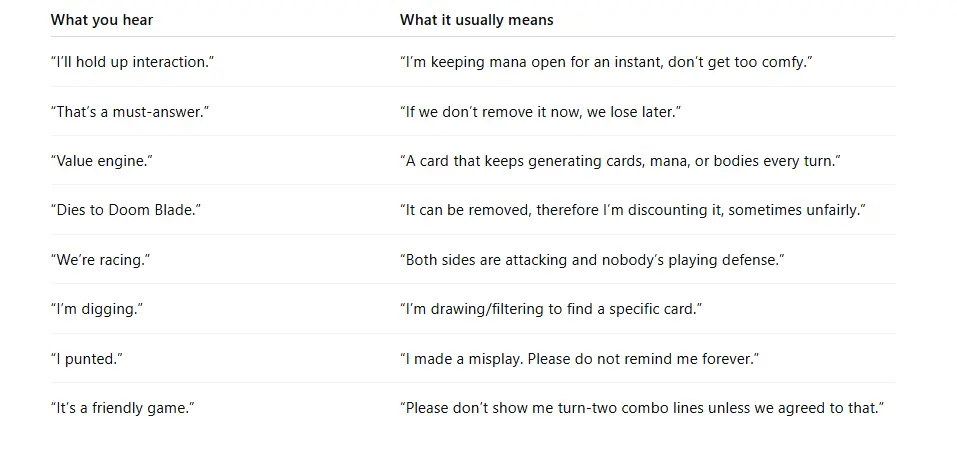
“What they said” vs “what it means” translation table
Because sometimes you don’t need a glossary, you need an interpreter.
FAQs
What’s the difference between “mana value” and “CMC”?
They refer to the same concept. “Converted mana cost” (CMC) is the older term. “Mana value” is the newer official wording. People still say CMC out of habit, like they still say “tape” when they mean “digital file.” Old brains are consistent, if nothing else.
Is “mill” actually an official term now?
Yes. It used to be pure slang named after Millstone. Wizards later made it an official keyword action, so now you can mill people with full corporate approval.
What does “Rule 0” mean in Commander?
It’s the pre-game agreement where players talk expectations. Power level, combos, proxies, and anything else that would otherwise explode into a debate mid-game.